ARE SYSTEMS AND PROCEDURES BENEFICIAL FOR A BUSINESS ORGANIZATION?


An organization with its foundation of a business unit, business function, teams, and its individuals look forward to growing and thriving through the endeavours they are engaged in daily. The term growth is a necessity for humanity in multiple dimensions, Since the pandemic alignment of resources to survive in business inducted complexity to structures and procedures in almost every industry. What was never a necessity and deemed medieval pre-pandemic is now an integral part and formed the foundation post-pandemic. With talks of recent and upcoming recessions- the expectation of growing and prospering should not be just a dream up in the air instead, a reality to thrive in an environment with set goals, objectives, continuous development, and adaptability to new changes without compromising on the founding principles of your business. The expectation of growth must established through basic primal routines with systems and procedures that can open opportunitiesto scale.
System and procedures are two components that go hand in hand and are detrimental to the success of any organization. A system is in place to accomplish an entire cycle of any deed from start to its entirety. Taking our own life as an example – Our life is an everyday system. However unruly or unorganized, there is still a basic system that one is accustomed to. Without even realizing it, going through our life cycle has become deeply ingrained in our minds and forms a part of our daily system. That’s one of the many benefits of systems – use them enough, and they become second nature. However, your system encompasses many different procedures.

You have a procedure for making your morning oatmeal, a procedure for how you style your hair, and a procedure for your morning commute. If even one of those procedures doesn’t go as planned (a traffic jam on your usual route, for example), your system may fail. Every business needs a system and a procedure to execute it so it doesn’t fail. A procedure, therefore, is simply one component of a larger system, and most systems are made up of a series of procedures.
A business System, without a goal, starts moving in all directions. As a result, coordination among all the parts (components) of the system is lost. Seamless integration of the system components is necessary to achieve the goal of the system, and close coordination is required between all the parts of the system. Coordination, flawless integration, and a steady growth plan are three important parts that encapsulate one system’s behaviour. Behaviour is governed by the procedures designed to ensure that components behave in ways that allow the system to achieve its goal. Further, every system has a life cycle and needs constant evolution with varying external environmental factors. The organization which adopts a systematic approach for its functioning has smooth operations for its day-to-day activities. The management of such an organization is simpler. Even when the business grows and expands with multiple moving parts, the behaviour and inner workings of a set system and procedures shall help run the business in auto-pilot mode.

Just as the system is important, Procedures form the basic understanding of system execution and set the tone for standard working procedures or, as we call it in modern day, standard operating practices (SOPs). As your business grows, the inner workings and the variables to drive the business forward increase, thus making it a business with many moving parts. These procedures have been found to be of immense use for proper working, training of the personnel and favourable outcomes in any organization.The procedures are an essential pre-requisite for the efficient working of the organization. Studies have shown that the procedures have significant potential to enable organizations to improve the quality of work without increasing costs. It is a set of instructions which instruct the employees on how to accomplish a task effectively, efficiently, and consistently. It is a set of instructions which addresses the ‘who, what, where and when’ of an activity. It is a document that describes the regularly recurring operations to ensure that they are carried out correctly (quality) and always in the same manner (consistency). Therefore, procedures are developed to provide clear guidance on how the process is to be operated and highlights the coordination needed for the smooth operation of the process. It can also be implemented as guidelines manifest for conducting training of the employees. Implementation of the so-called procedure ensures timeliness, consistency, technical excellence, and accountability of the process.
Businesses with foundations of sustainable and robust systems further provide confidence to make conscious investments into their successful functions. Thus, it is paramount that leaders today give careful and high-priority efforts to developing systems along with people. Most businesses find it tough to retain their employees. The main issue with attrition is not just that we lose talent among our workforce, but issues like loss of knowledge capital and business know-how. Also, training recruits to replace the employee who left is time-consuming and expensive. Instead, well-established systems and procedures will help an organization mitigate these issues and make the employees’ life easier giving them more time to invest in self-development. Finally, these systems must be reviewed, evaluated, monitored, and updated frequently as the needs and expectations change. The best bet for organizational growth is such dynamic and sustainable systems. The future is already here, with exciting new levels reached in robotics through Artificial intelligence (AI). In reality, AI is taking over, and in many organizations’ tasks are automated. But have you ever thought about where AI comes from? AI is nothing but a fancier version of the summarized form of Systems and Procedures. AI is the automated intervention of our organizational setup of systems and its procedures through algorithms that are made to machine learn its everyday process. By this,human interaction is set to minimal but the functions of a system with its procedure remains the same, thus underlining the importance of having thorough and well thought out systems and process in place for business longevity.

The past has been set in stone, with various business organizations leaving their footprints of success on the sand for others to follow, thereby making them the predecessors to what we see today. The present is aligned with reality and the need for constant improvements in a quest to be the best with simple systems and process iterations that help any business move forward. As I mentioned earlier, the future is already here in the form of machine learning or AI, where endless tasks are now functioning in an automated fashion. However, one should not forget that this future is the reward of our past iterations and the present continuous improvements which have set unprecedented benchmarks in today’s business world.
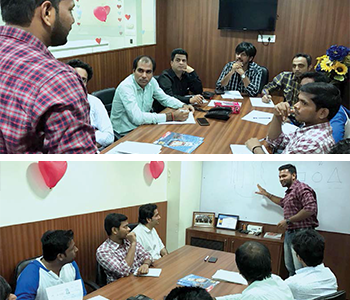 The staff at CSS Mumbai witnessed a unique training session recently. The pens and pads they carried to the conference room proved to be of no use when the training started. It was all about Martial arts and self-defence techniques. Even though the session brought in surprises and beaming smiles on faces, in the hind sight, everyone agrees that the training they got was one of the most important lessons which the time demands in India.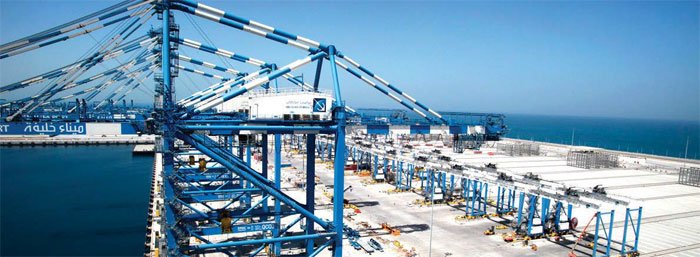
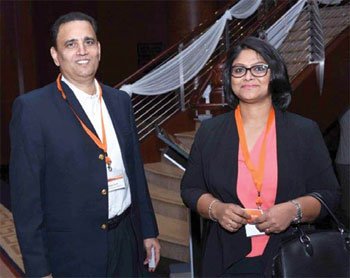 CSS Group participated at the 70th anniversary celebrations of Safmarine recently held in Dubai. The milestone achievement was celebrated by Safmarine, inviting their industry partners and well-wishers for a cocktail dinner and entertainment evening on the 01st June, at the Al Wasl ball room of Dusit Thani in Dubai. CSS Group was represented by Seshan Janik, Vice President NVOCC and Angeli Sudheer, Manager Pricing and Customer service.
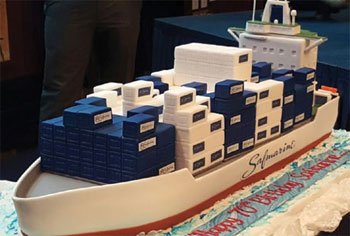 “CSS enjoy a warm and cordial business relationship with Safmarine which was established more than 5 years ago. It has been a wonderful relationship and we have gone at great lengths to jointly develop business across global markets. We are extremely delighted to be a part of this wonderful celebration”, mentioned Seshan Janik.
 CSR activities have always been an integral part of CSS for the last two decades of its service in the UAE and India. By participating in the charity initiatives of the UAE government CSS has always demonstrated its responsibility in giving back to the society.